


HOME OS Group Featured in PHILE WEBOS, a leading screen brand: An exclusive factory tour reveals the secrets behind their premium quality
If you are a Phile-web reader, you have likely heard of the brand "OS." They are one of the rare manufacturers that still produce premium projection screens an essential component of home theaters domestically in Japan.
Their high quality and diverse product lineup are highly regarded, earning them deep trust among professional home theater installers.
Beyond their own OS-branded products, they also handle the import and distribution of items such as Optoma projectors and Vogel's mounting brackets. Including their B2B solutions, the volume and variety of product categories they handle are quite extensive.
In this article, we explore the OS Group's latest initiatives and the highly anticipated new models that Phile-web readers have been waiting for.
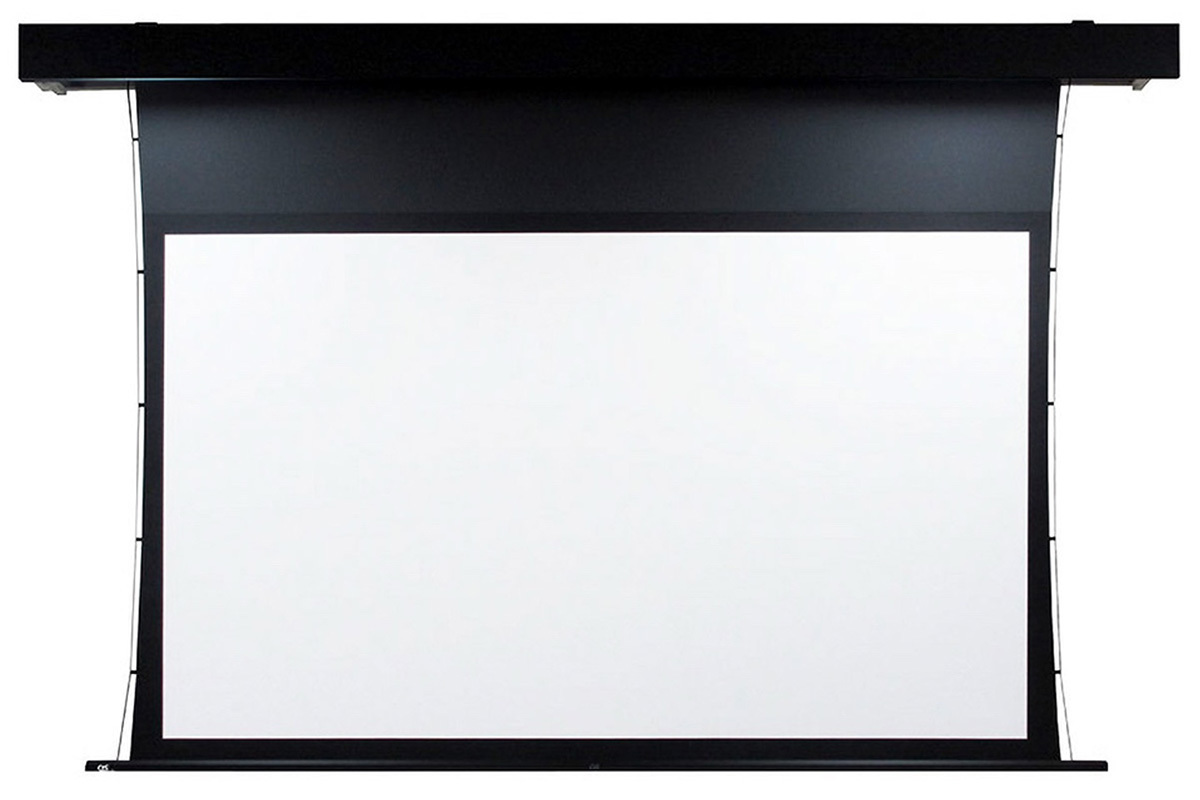
The OS brand offers a wide variety of screen fabrics and mechanisms. Pictured here is a tab-tensioned electric model (TP) featuring the "REIRODORU" (HF102) screen fabric.
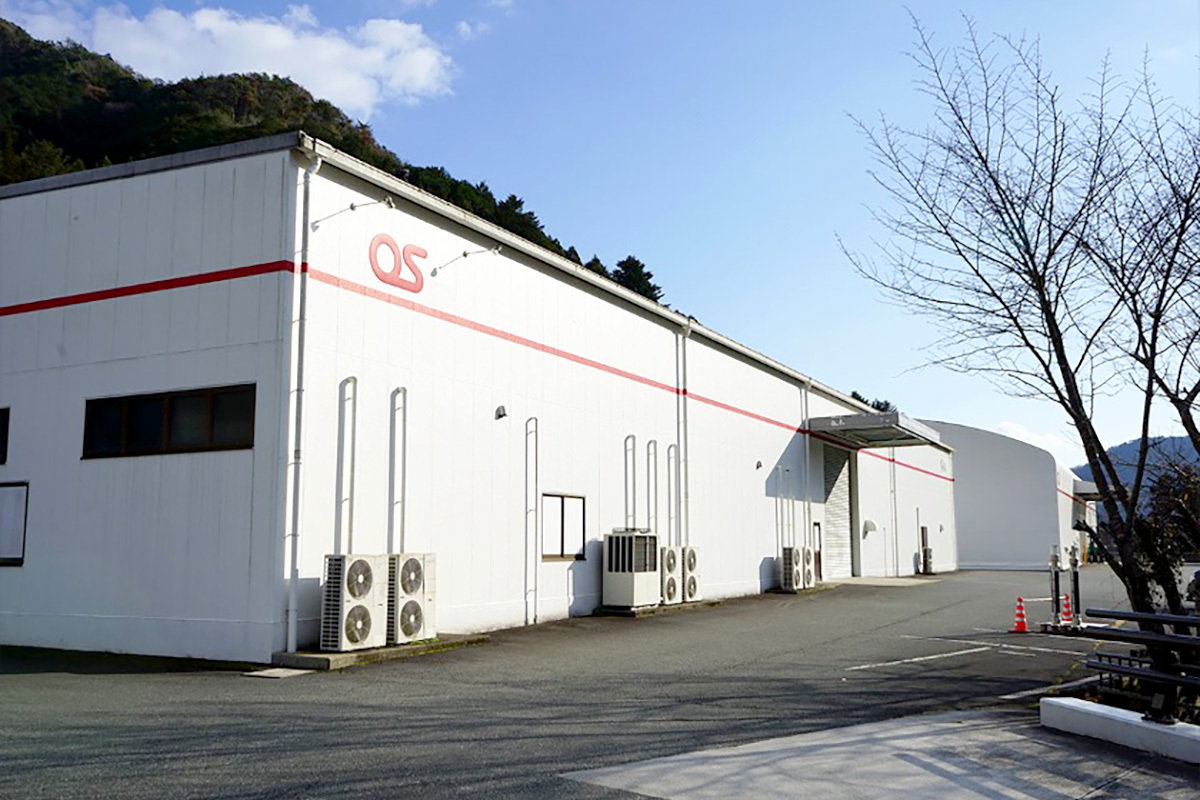
OSM Hyogo Factory (Shiso City, Hyogo Prefecture): An R&D-oriented manufacturing facility managing a wide range of operations for the OS Group.

OS Co., Ltd. was founded in 1953 in Sakai City, Osaka, as Okumura Shokai. Initially specializing in the manufacture, sale, and installation of cinema screens, the company later expanded into the educational market with OHP (overhead projector) screens and display mounts. Reflecting its growth, the company was renamed OS Screen Co., Ltd. in 1967, and subsequently OS Co., Ltd. in 1988.
In 1991, Masayuki Okumura, the current Representative of OS Group, Masayuki Okumura was appointed President. Recognizing the rising popularity of home LCD projectors at the time, the company strategically enhanced its lineup of home theater screens.
Today, the OS Group operates through six domestic and two overseas companies, with each entity specializing in areas such as domestic and international business, as well as fundamental and applied research. Within this structure, OSM Co., Ltd. is responsible for the core operations, including product planning, R&D, procurement, manufacturing, sales, and maintenance.
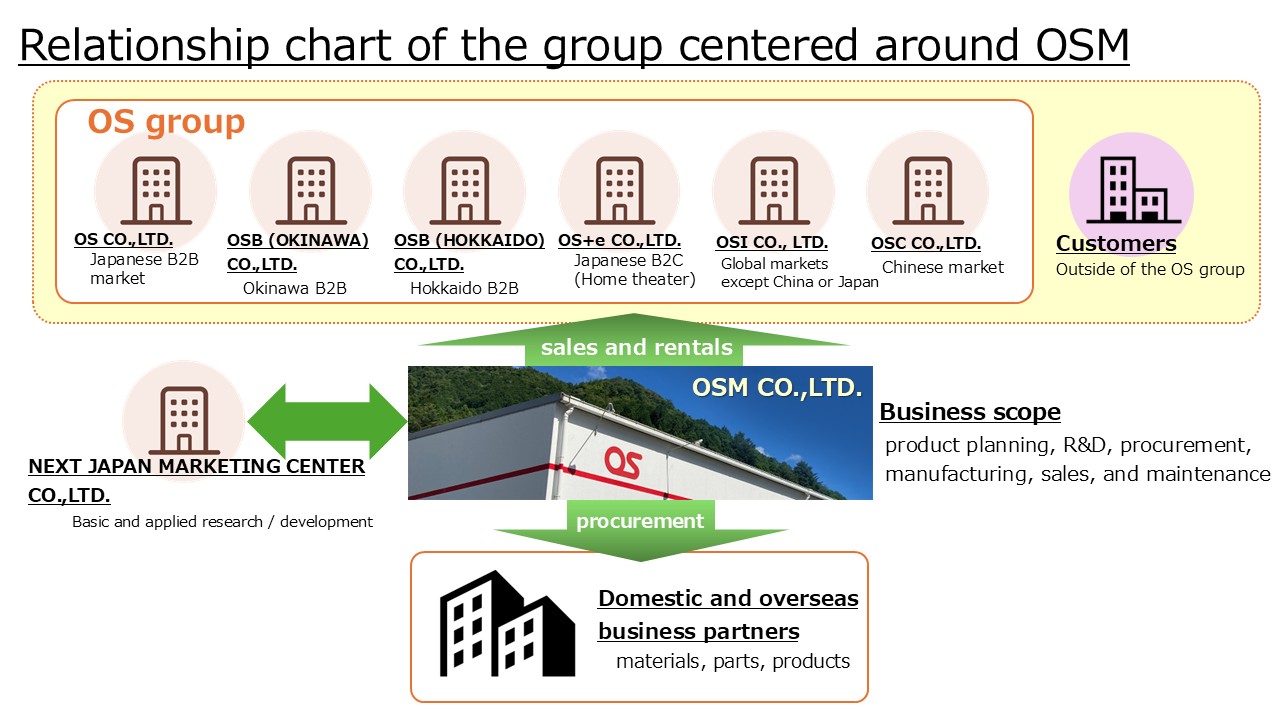
OSM: The core of the OS Group, handling the entire product lifecycle from planning and R&D to manufacturing, sales, and after-sales support.
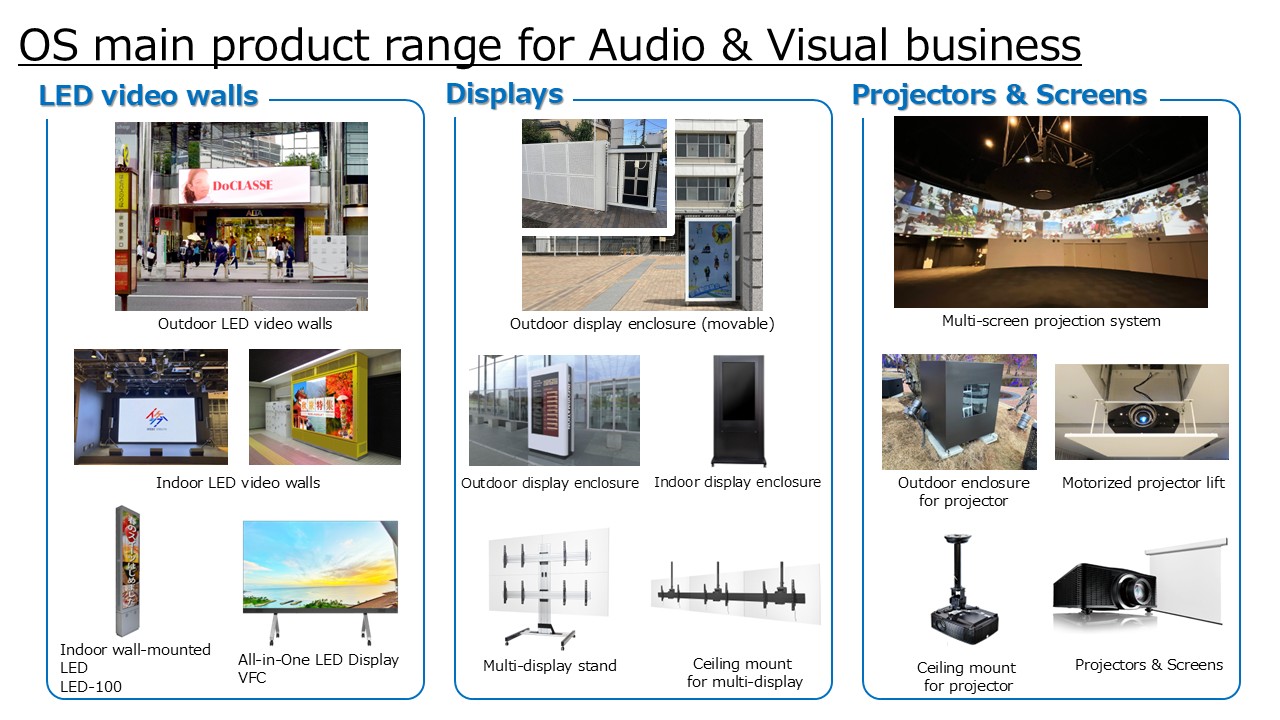
The OS Group's business operations are broadly categorized into five segments: Audio-Visual, Renewable Energy & Disaster Preparedness, Education, Contract Development, and Food Tech.
In the Audio-Visual segment, their offerings cover a wide spectrum. These range from large-scale applications like projection mapping and LED video walls, to projectors and screens tailored for educational and home use.
Their Renewable Energy & Disaster Preparedness segment features unique, proprietary solutions, including thin-film solar sheets, portable rechargeable batteries, and their original "Off-Grid Self-Powered Pole," such as those installed in front of Ayase Station in Adachi City, Tokyo.
The Education segment represents another highly unique endeavor. With the aim of passing down over 70 years of manufacturing expertise to the next generation, the group hosts events and the "Monozukuri Dr. KidsKey Academy" at the OS Tokyo Building, providing elementary and junior high school students with hands-on exposure to the full scope of manufacturing.
The company's deep commitment to education is evident in their development of original educational kits, such as the "Mini Vegetable Factory Kit" and "Solar IC Music Box." These are specifically designed for children to assemble during workshops and practical school lessons.
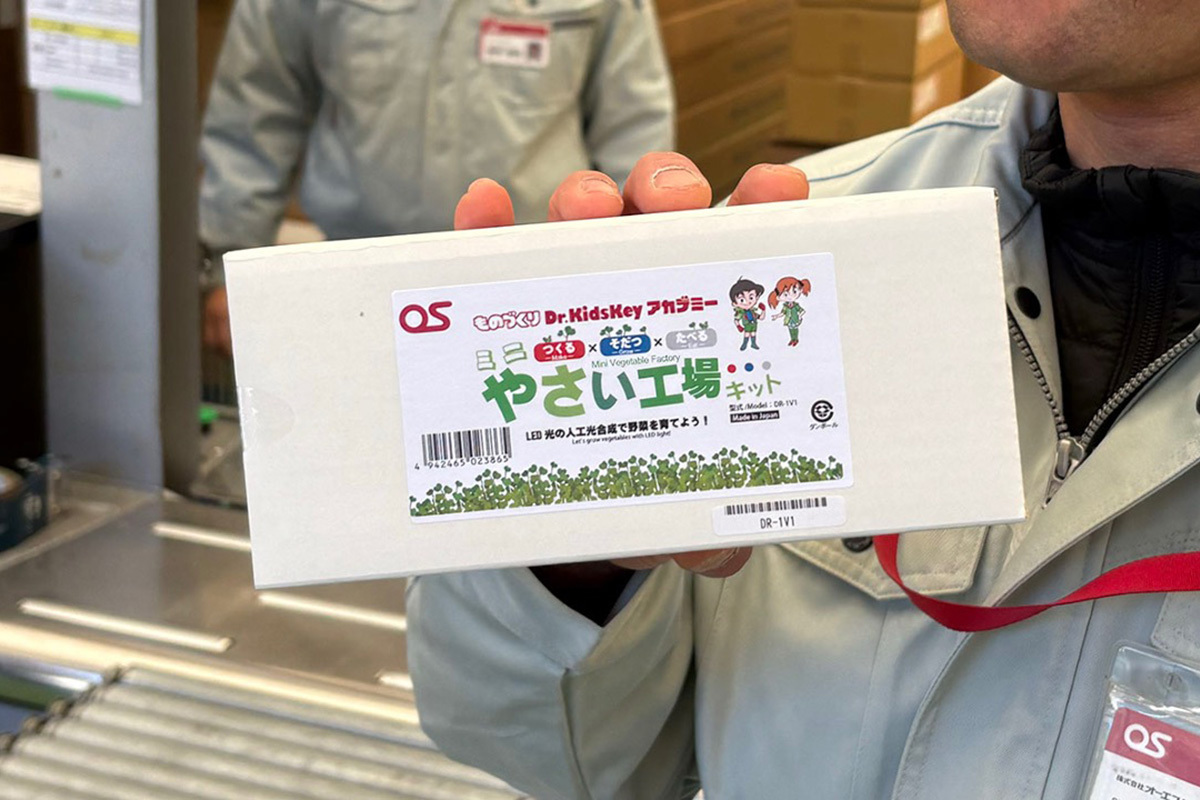
The "Mini Vegetable Factory Kit" is an electronics project kit that grows vegetables using LED-powered artificial photosynthesis. It is actively utilized in both OS Group-sponsored events and in formal educational settings.
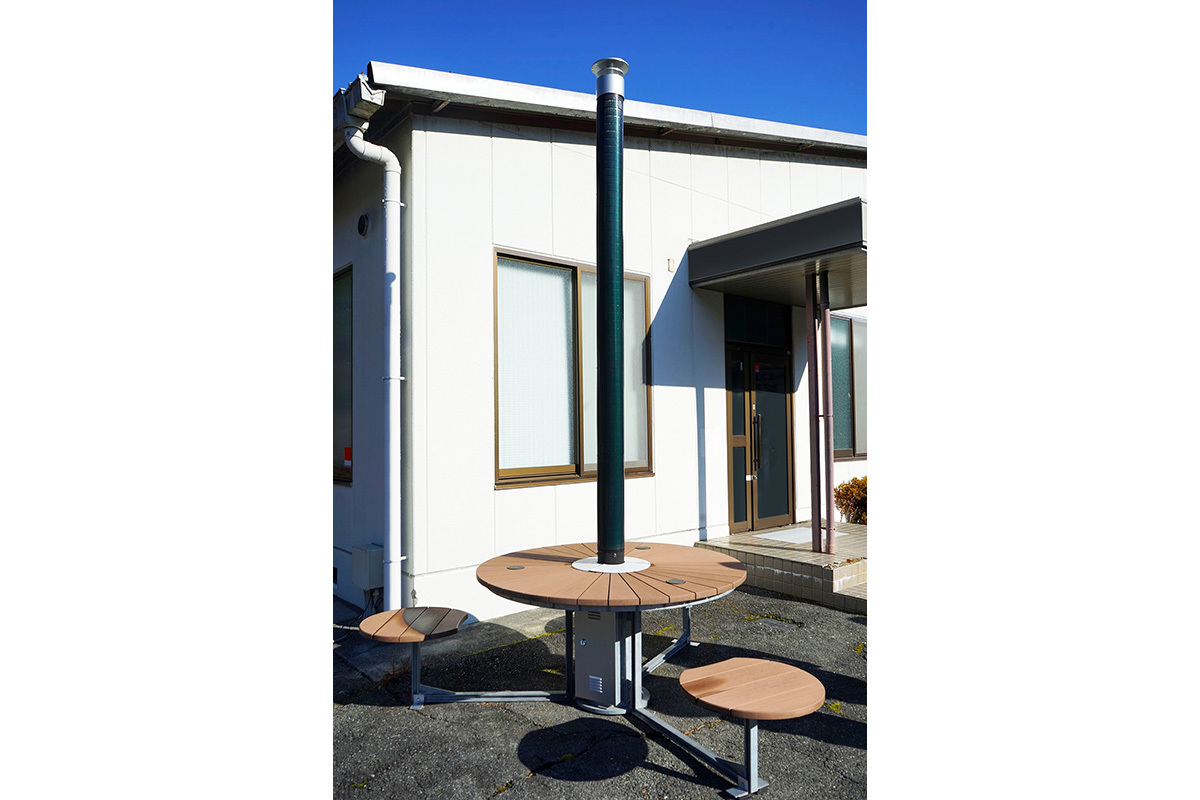
"TAKKEI," an off-grid charging table, features flexible solar sheets wrapped around its pole to generate power and store energy in an internal battery. This jointly developed solution is already in active use, enabling wireless smartphone charging right at the tabletop.
We recently had the opportunity to visit the OSM Hyogo Factory for an exclusive report. We were welcomed by a distinguished group of leaders from the OS Group, including Masayuki Okumura, Representative of the OS Group, and Yoshio Kanan, Managing Director of OSM and President of OS Plus e Co., Ltd.
Joining them were several key figures, driving the company's operations: Mitsuhiro Yamane, General Manager of the R&D Division; Shinya Morishita, Manager of the Production Division; Yohei Fujiwara, Section Manager of the Screen Manufacturing Department at OSM; and Jun Ishida, Section Manager of the EC Sales Department at OS Plus e.
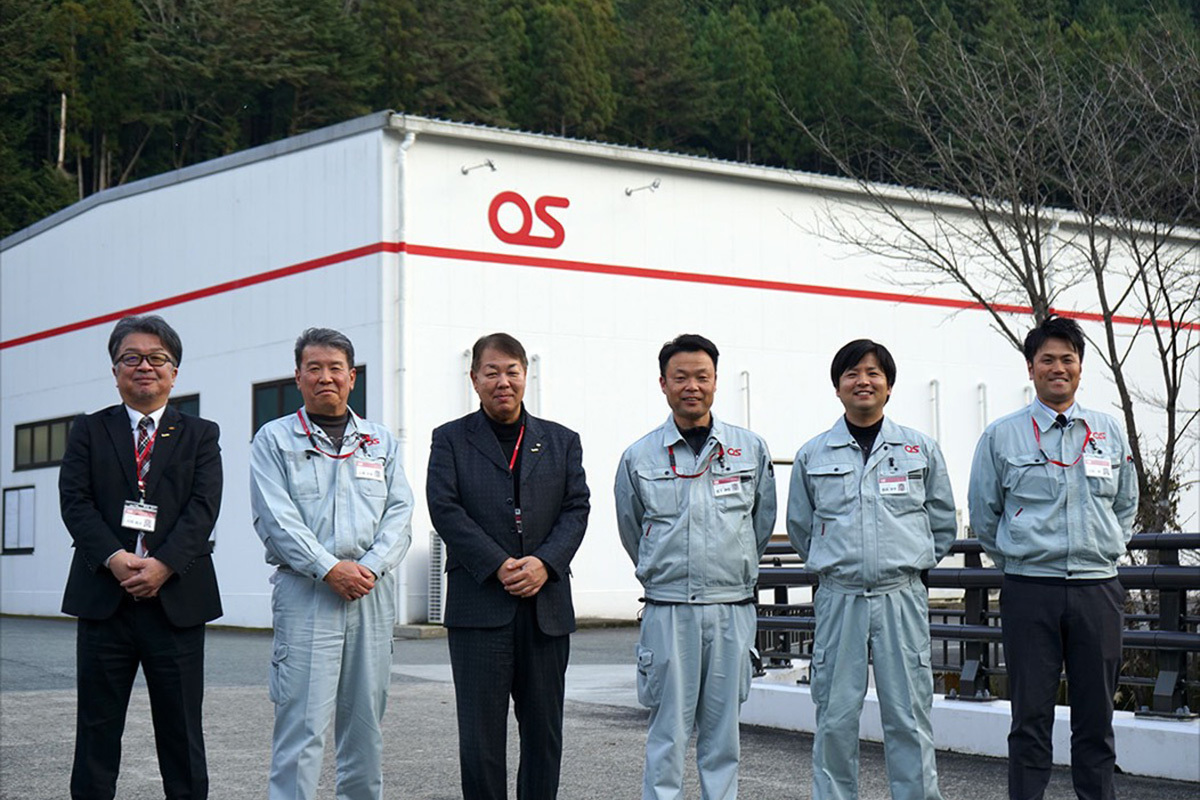
The OS Group leadership and engineering team.
Located in Shiso City in the mid-western part of Hyogo Prefecture, the Hyogo Factory sits in a strategic transportation hub offering convenient access to Osaka, Kobe, Okayama, and Tottori.
The area is known as the site of Harima Yamasaki Castle once the residence of Kanbei Kuroda (Yoshitaka), the renowned strategist for Hideyoshi Toyotomi. Shiso City is also celebrated as the birthplace of Japanese sake; according to the Harima no Kuni Fudoki (ancient records), Niwata Shrine in Ichinomiya-cho was the first to use koji to brew sake for a divine offering.
Completed in 1990, the Hyogo Factory was originally built to meet the rising demand for LCD projector screens. Today, it houses the R&D, Production, Production Management, and Sales divisions, serving as the central pillar for the OS brand's quality assurance.
In the context of its origins in manufacturing professional-grade equipment, the factory excels in providing complex, integrated solutions.
The Production Engineering Department acts as the Project Management (PM) command center, coordinating a wide array of technical disciplines including materials, electronics, telecommunications, control systems, and mechanical engineering. This "Vertical Integration"-completing everything from development to production within their domestic facility stands as the company's greatest advantage.
This feature article provides an in-depth look at the Hyogo Factory. Before diving into the details, we spoke with Representative Masayuki Okumura to explore the OS Groupʼs underlying manufacturing philosophy and core principles.
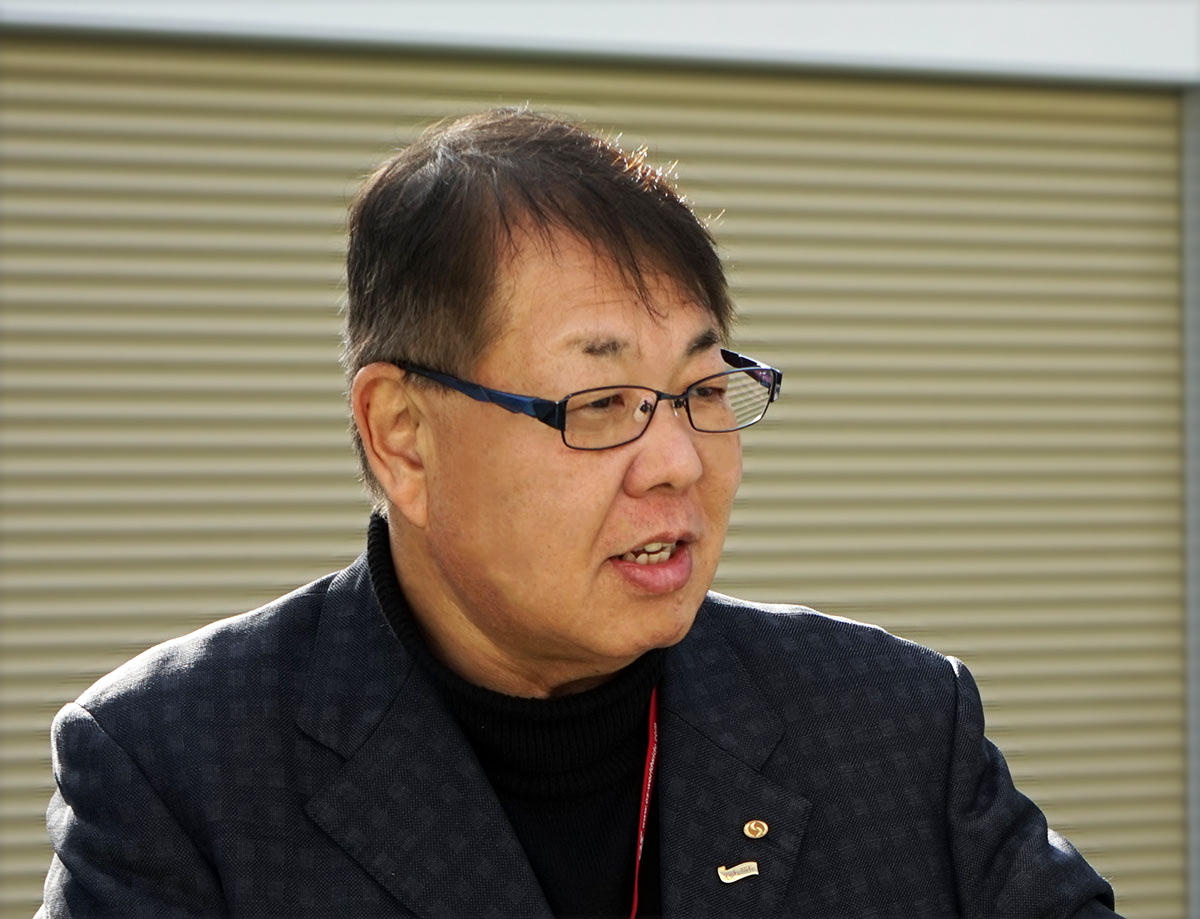
Masayuki Okumura, Representative of the OS Group
"At our founding, we manufactured fixed-frame screens for cinemas. Around the time we began producing screens for schools, we established our core identity as a screen manufacturer around two distinct 'Maku' technologies: the technology of 'Rolling' (maku) and the technology of the 'Screen Surface Materials' (maku) itself. As visual equipment has evolved and requirements have shifted over the decades, we have consistently built the foundation for visual experience."
"The application of our screens has expanded from schools to business and home theaters. Throughout this evolution, we have never wavered in our commitment to developing materials tailored to specific environments and content, taking full, end-to-end responsibility for quality across the OS Group."
"For any screen surface, the key is the delicate balance between reflective characteristics and surface uniformity. Our journey began with cotton, moved to PVC + glass fiber + resin processed materials composites, and led to the development of our proprietary fabric-based materials. By incorporating specialized surface coatings, we have refined these into the screen surfaces we offer today."
"At OS, we have continuously evolved the screen material itself to keep pace with the constant evolution of both projectors and visual content," says Mr. Okumura.
A screen is composed of three core elements: the screen surface (fabric), the rolling and housing mechanism, and the control circuit board. OS develops all these components in-house and holds numerous proprietary technologies.
Regarding screen surfaces, the current lineup and features for home theater applications are as follows:
A diffusive surface with a neutral quality, engineered to achieve the ideal balance between sharp focus and smooth light dispersion.
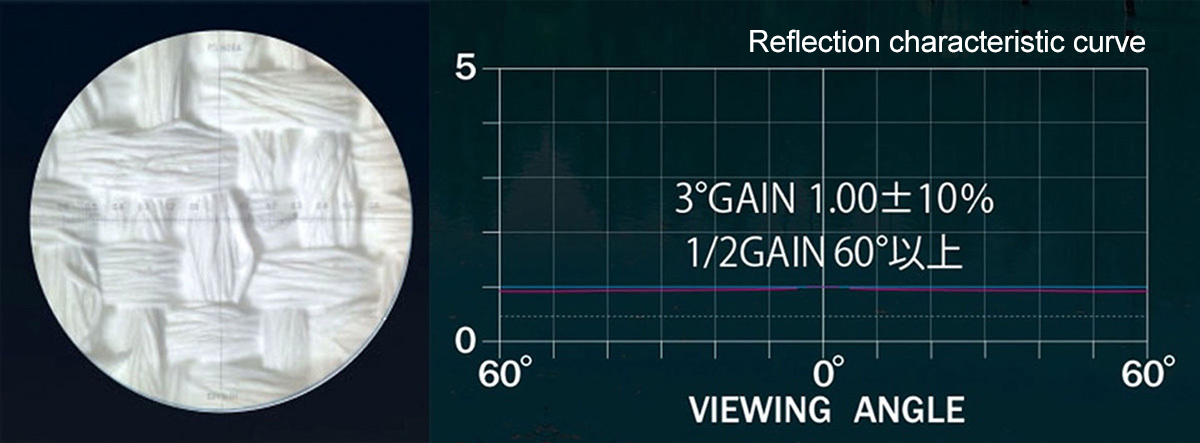
4K 3° Peak Gain 1.00±10%
The worldʼs first projector screen to be certified as HDR-optimized. This high-gain surface is specifically engineered to maximize High Dynamic Range (HDR) performance. Surface treatment minimizes interference from ambient light, achieving a profound visual contrast characterized by luminous whites and defined blacks.
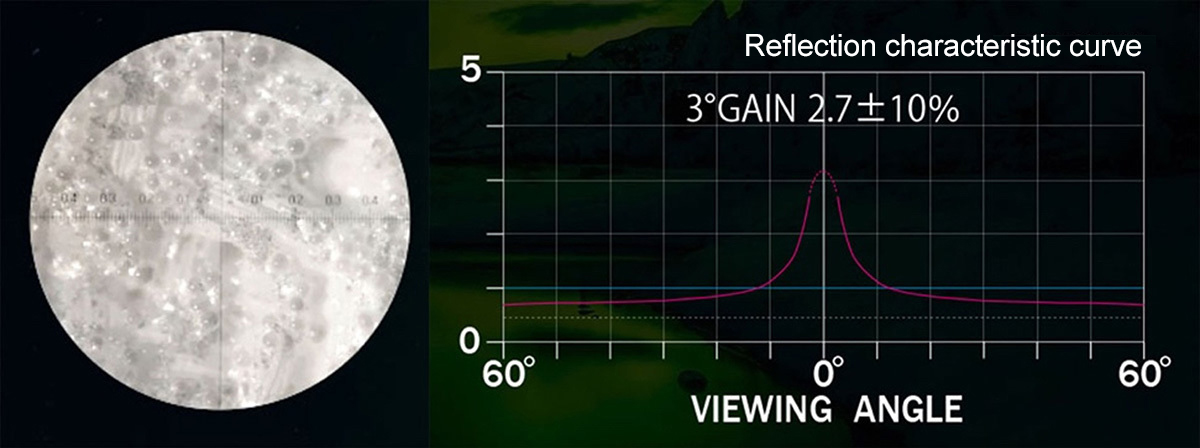
3°Peak Gain 2.7±10%
The high-density glass bead coating minimizes the impact of ambient light. A retro-reflective type effective for mitigating ambient light. It features brilliant white peaks, reproducing bright images without highlight clipping.
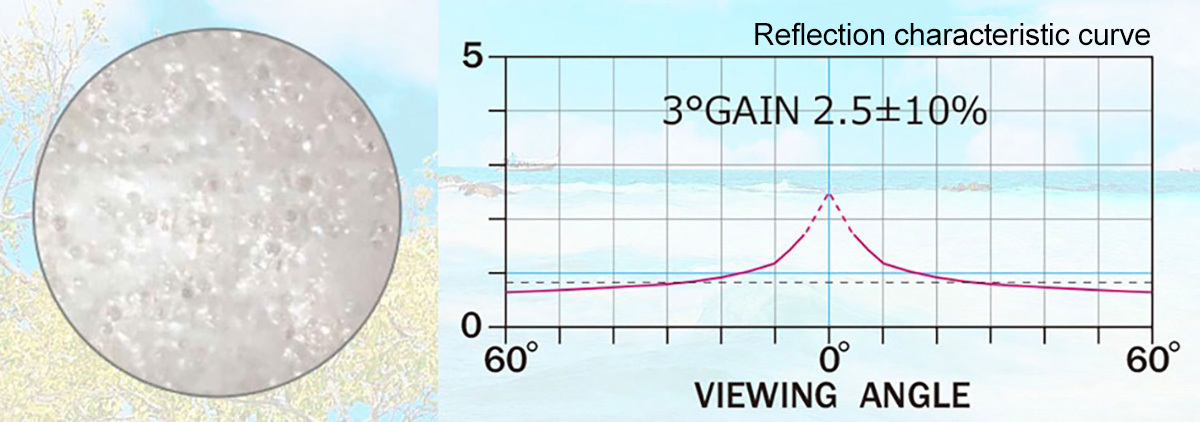
8K/4K/3° Peak Gain 2.5±10%
Gain: A measure of light reflectivity; a higher value reproduces a brighter image.
3-degree Gain: The standard gain value measured at an angle 3 degrees off the central axis (light axis) of the screen.
We spoke with Mr. Fujiwara, who leads screen development, to learn about the development story behind this product lineup.
"Our development is driven with the aim of delivering visual content in its absolute best condition, according to advancements in projector performance and content quality. While our primary focus was previously on black-level gradation, the mainstream adoption of 4K has shifted the demand toward 4K resolution and HDR compliance. To meet these evolving needs, we have extended our development process to include evaluations of reproducibility."
"Our material engineering began with achieving superior surface uniformity in the finished product while remaining mindful of light reflection characteristics."
"Beyond securing reflection characteristics and surface uniformity, we addressed further technical challenges. We achieved both weight reduction and curl resistance by using glass fiber with resin processing to ensure flatness, while simultaneously improving the base material and optimizing the balance between the front and back surfaces. Furthermore, by utilizing ultra-fine polyester fiber and specialized coatings, we pursued the mitigation of moiré artifacts and the precise reproduction of whites."
"This evolution has been driven by a consistent cycle: identifying challenges, selecting materials, determining material composition, refining processing techniques, and conducting rigorous product evaluation." (Mr.Fujiwara)
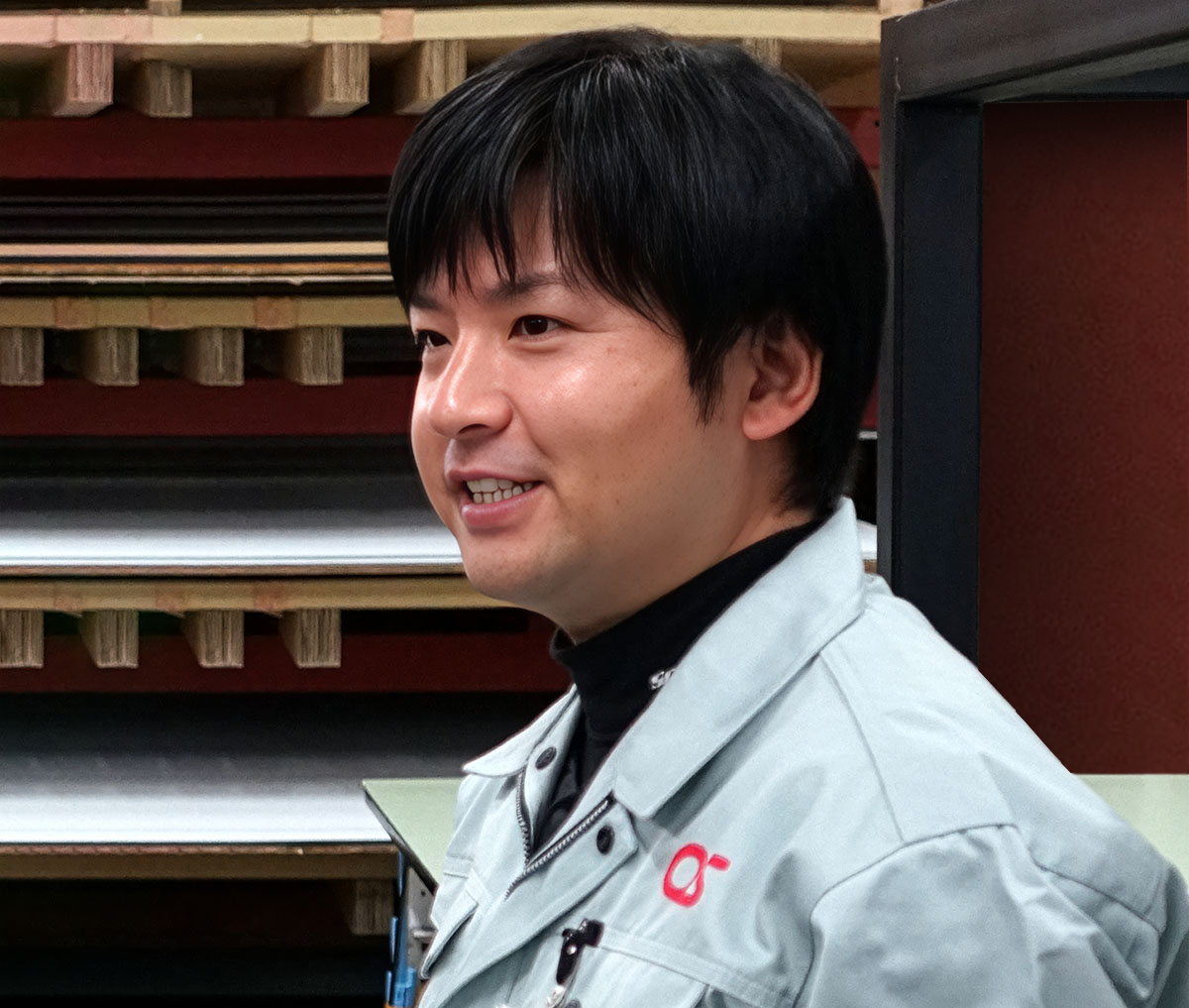
Mr. Yohei Fujiwara Manager, Screen Manufacturing Department, Production Headquarters, OSM Co.,Ltd.
Furthermore, we sought his advice on the key factors to consider when choosing a screen surface for a home installation.
"The true fascination of choosing a screen lies in how the ideal choice shifts depending on your 'home's lighting' and 'the specific content you wish to watch. Ambient light is the critical factor here; by effectively controlling it, you can dramatically elevate the image quality."
"In brighter settings like living rooms, the primary challenge is minimizing the impact of ambient light; for this, we recommend AKIREI II, which is specifically designed for effective light control."
“Conversely, in a dark room, the focus shifts to shadow detail, depth of blacks, and color accuracy.
To truly experience the nuances of cinema, I suggest choosing Pure Mat III Cinema—a diffusion-type screen—for its superior color reproducibility, or REIRODORU—an HDR-optimized—for its exceptional color naturalness and profound black levels.” says Mr.Fujiwara
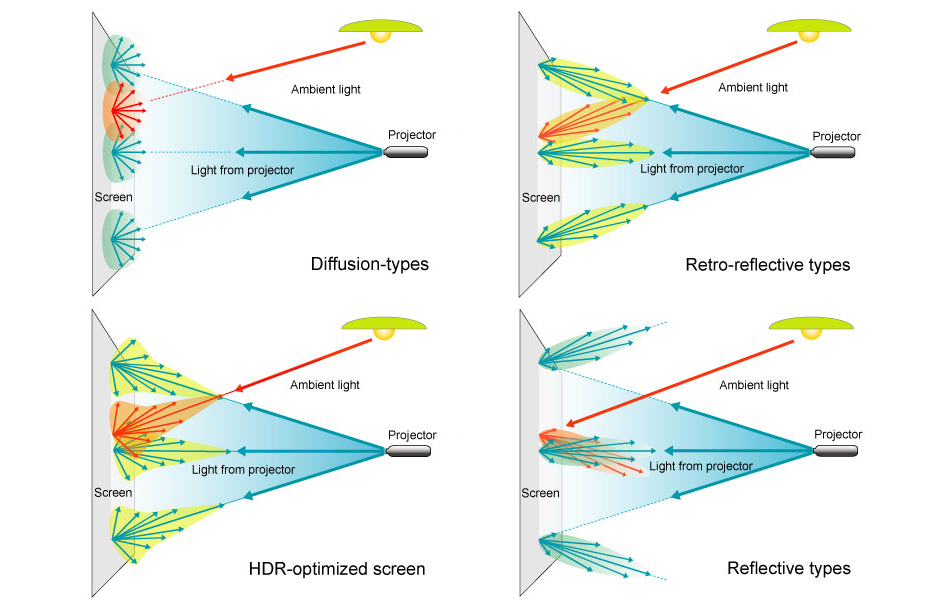
The optical characteristics of front-projection screens used in home theaters can be categorized into four primary types.
Diffusion-types (White Mat) reflect projected light uniformly, while Retro-reflective types (Beads) have the unique property of reflecting light back toward its source.
HDR-optimized screen is athin more recent development, specifically engineered for HDR-capable projectors. Finally, Reflective types (Pearl/Silver) utilize specular reflection, bouncing light at an angle equal to its arrival.
In response, Mr. Kanan provided an explanation regarding the key points the OS Group prioritizes in its recent screen development.
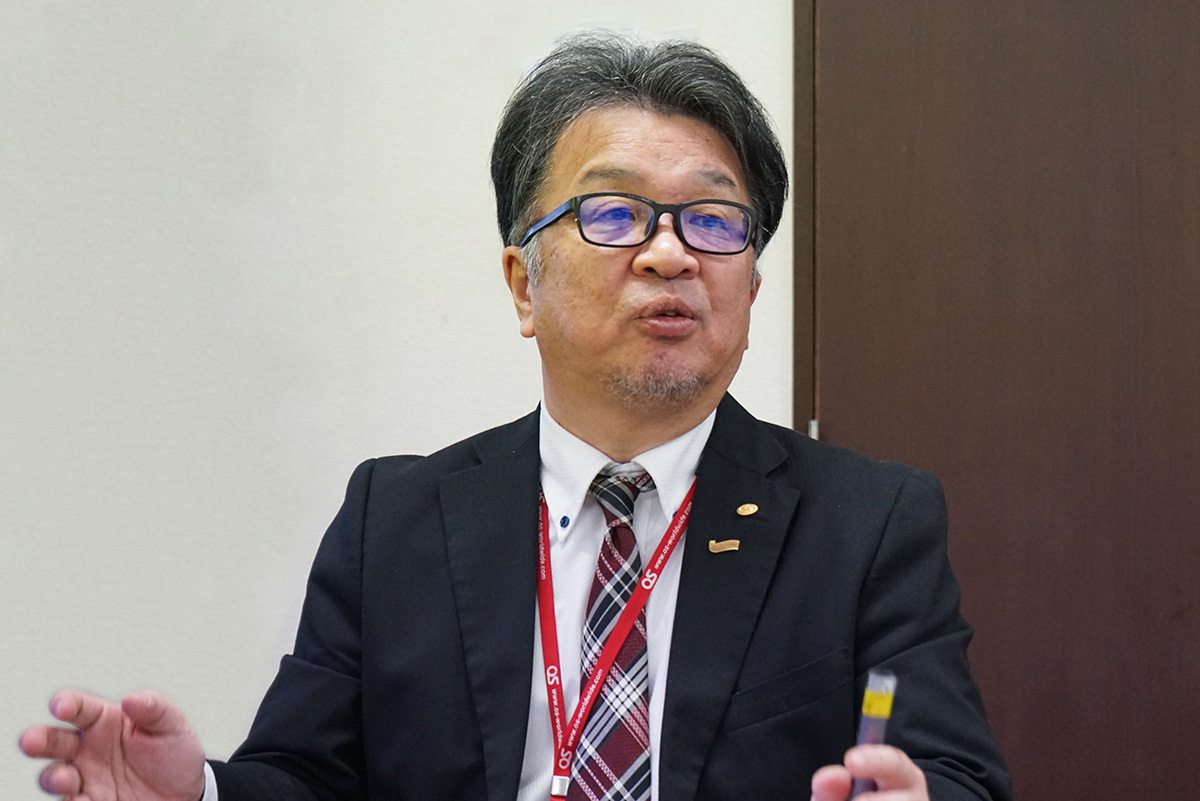
Yoshio Kanan, Managing Director of OSM Co., Ltd. and President of OS Plus e Co., Ltd.
“The higher the resolution of the projector, the more apparent the differences between screens become. This is precisely why screens must evolve, right down to how they present
4K/8K and HDR content. While some manufacturers define the criteria for a 4K screen solely as "Elimination of moiré artifacts", at OS, we consider that to be nothing more than one basic element of 4K compatibility.”
“To fully bring out the potential of 4K images, it is essential not only to eliminate moiré artifacts but also to ensure high-gain performance for sufficient brightness, nuanced gradation that naturally distinguishes every shade from white to black, and a microscopic surface structure refined enough to support ultra-high-definition.”
“At OS, we take a comprehensive approach to these four key elements—high gain, gradation, high definition, and elimination of moiré artifacts. Rather than prioritizing any single factor, our screen development focuses on achieving the most balanced performance to deliver an optimal visual experience.”
“We developed REIRODORU to produce specular white highlights without overexposure while preserving black depth.
AKIREI II was designed to further enhance the peak brightness of whites. In this 4K era, screens must be backed by a total engineering approach that truly supports the creator's visual expression.” states Mr. Kannan.
Additionally, OS Plus e Co., Ltd. operates a rental business, providing immersive visual experiences for everything from private use to corporate meetings and seminars through a wide selection of projectors and screens.
For critical events where failure is not an option, the company offers expert consulting to ensure integrators select the perfect projector and screen pairing for their specific architectural environment, along with identifying any other necessary hardware. Inquiries are welcome directly through their website.
For readers interested in a convenient way to experience a home theater over the weekend, equipment rentals are available through the OS Plus e website. We invite you to visit the site and explore the possibilities for your next viewing experience.
 Company Profile